30 YEARS SINCE THE PANIS–LIGIER TRIUMPH IN MONACO
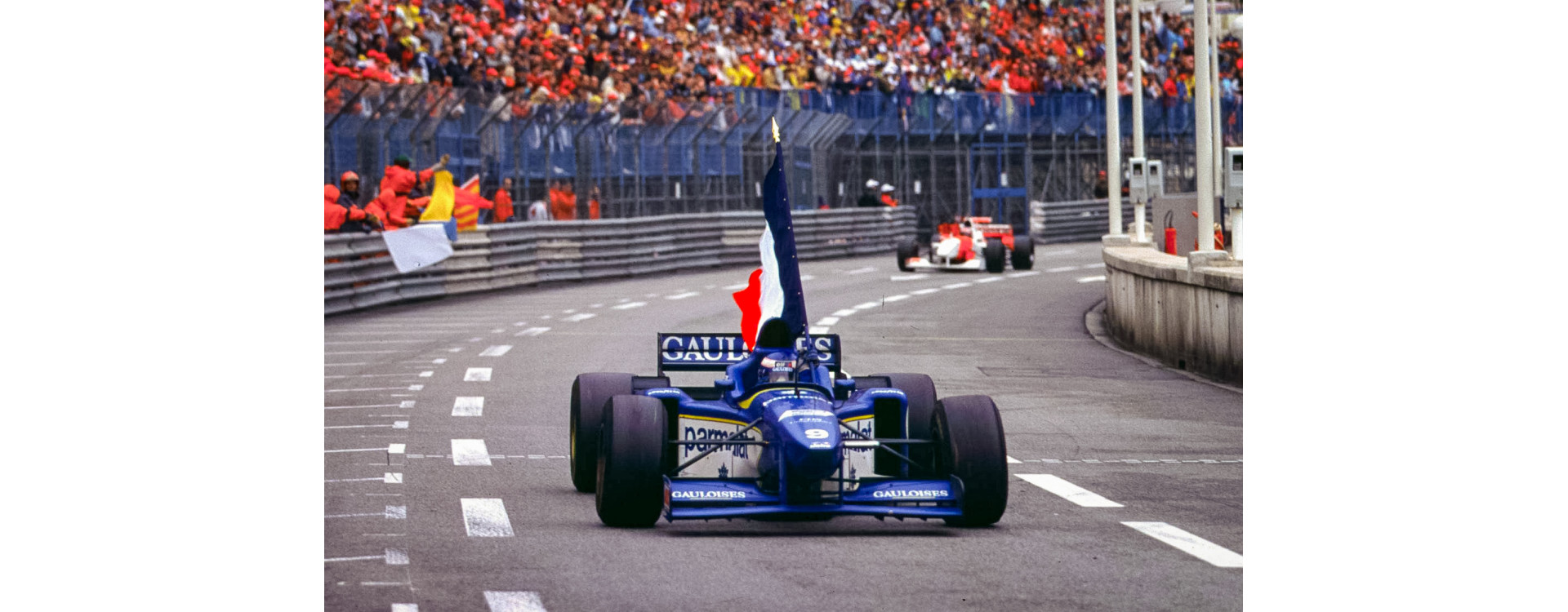
Olivier Panis and Ligier Automotive will celebrate the 30th anniversary of Ligier’s Monaco victory in 1996 at the KENNOL Grand Prix de France Historique (May 8–10, 2026).
This anniversary — that of the last victory by an F1 car assembled in France — will also coincide with the 50th anniversary of Ligier in Formula 1. An exhibition and demonstration runs will retrace the manufacturer’s remarkable motorsport story. Five former drivers from the team will also be in attendance.
Panis celebrates the 30th anniversary of his Monaco victory
Seven Ligier racing cars on display
Five former Ligier drivers present
On May 19, 1996, Olivier Panis won the Monaco Grand Prix to widespread surprise. This victory remains one of the most memorable in the entire history of Formula 1, because nobody saw it coming, and for good reason:
In 1996, the Ligier team had not won a race for 15 years;
That day, Olivier Panis started only 14th on the grid, on a circuit where overtaking is almost impossible.
From the opening laps, the Grenoble-born driver took advantage of a few retirements to gain positions, then a well-timed pit stop helped him pick up several more. Above all, he produced a series of spectacular overtakes on a track made extremely treacherous by the rain: Martin Brundle (Jordan) on lap 7 in the Beau Rivage climb, Mika Häkkinen (McLaren) on lap 15 at Mirabeau, Johnny Herbert (Sauber) on lap 25 at the Loews hairpin (now Fairmont), then Eddie Irvine (Ferrari) on lap 36, again at the Loews hairpin. In the closing stages, Olivier Panis had to monitor his fuel consumption while keeping David Coulthard (McLaren) at bay, eventually taking victory after two hours of effort.
At the time, no one yet knew that this win would go down in history as the last Formula 1 victory for a car assembled in France (at Magny-Cours, in this case). It would then take 24 years — until Pierre Gasly’s victory at the 2020 Italian Grand Prix — for a French driver to win again in Formula 1.
On May 8, 9 and 10, the KENNOL Grand Prix de France Historique will celebrate the 30th anniversary of this feat, one of the greatest in French sporting history. Olivier Panis will be present and will share his memories of that famous Sunday, May 19, 1996.
FIVE LIGIER DRIVERS REUNITED
Beyond this legendary victory, it is Ligier’s entire motorsport history that will be celebrated, 50 years after the team’s Formula 1 debut. Five former drivers of the famous blue team will be present: Jacques Laffite (1976–1982 & 1985–1986), René Arnoux (1986–1989), Philippe Alliot (1986, 1990), Stefan Johansson (1988), and Olivier Panis (1994–1996).
ICONIC LIGIERS ON DISPLAY AND IN ACTION
An exhibition and several demonstration runs will cover more than 50 years of Ligier history, from the 24 Hours of Le Mans to Formula 1, including rallying. The immersive staging will feature a wide range of original team parts and artefacts: drawing boards, wind tunnel models, moulds, race suits, and more.
Ligier JS2 (1973)
A Formula 1 driver for Cooper and Brabham, and a Le Mans competitor in the Porsche 904 and Ford GT40, Guy Ligier changed status in 1969 when he fulfilled his dream of “building a good car.” From that ambition came the JS1, bearing the initials of his friend Jo Schlesser, who had been fatally injured the previous year at the Rouen-Les-Essarts circuit. Designed to compete with the Porsche 911, Alpine and Dino Ferrari, the coupé was also developed in a racing version that scored two promising victories at Albi and Montlhéry. Its successor, the JS2, was never homologated in the GT category due to insufficient production numbers, forcing Ligier to develop it instead as a “Silhouette”-style sports prototype. No matter: it achieved a one-two finish in the 1974 Tour de France Automobile with Gérard Larrousse and Bernard Darniche, then finished second in the 1975 24 Hours of Le Mans with Jean-Louis Lafosse and Guy Chasseuil, just one lap behind the winning Gulf Mirage.
Ligier JS9 (1978)
Ligier’s performances in rallying and endurance racing had highlighted the team’s expertise. A perfect alignment of circumstances saw that success coincide with Matra’s withdrawal from motorsport at the end of 1974. Gérard Ducarouge, Paul Carillo (draftsman), Lionel Hublet (chief mechanic), and sponsor Gitanes then made their way to Vichy. The first in-house Formula 1 car, powered by the Matra V12, made a sensation in its debut season in 1976. Jacques Laffite took three podium finishes, then secured the team’s first victory the following year in Sweden. With Jacques Laffite, Patrick Depailler and Didier Pironi, the team would go on to win seven more times between 1979 and 1981, fighting for the title three years in a row and becoming World Championship runner-up in 1980. Designed by Gérard Ducarouge, Michel Beaujon and Robert Choulet, the JS9 presented at the GPFH embodies the very best of French Formula 1 know-how.
Ligier JS27 (1986)
This car remains in history as the last Ligier to play a major role in Formula 1, before the resurgence of 1993 and the isolated victory of 1996. At its wheel, Jacques Laffite finished third in the Brazilian Grand Prix and second in Detroit, placing sixth in the championship at mid-season. But in Britain, he was caught in a pile-up at the start and broke both legs. The second half of the season proved more difficult for Philippe Alliot and René Arnoux, as the turbocharged Renault V6 prepared by Mécachrome evolved less quickly than the factory-supplied version used by Lotus. Designed by Michel Têtu, Michel Beaujon and Claude Galopin, this single-seater was notable for its moulded carbon-kevlar monocoque chassis, a technology still rare at the time.
Ligier JS33B (1990)
In 1987, Renault’s withdrawal pushed Ligier towards Alfa Romeo, whose engine turned out to be a fiasco from the very first tests. It was urgently replaced by the Megatron four-cylinder derived from the BMW unit. Engines changed from season to season — Judd, Ford, then Lamborghini — but the Ligiers remained stuck at the back of the grid, and the team scored no more than three points between 1988 and 1991. Built in the Magny-Cours factory, the JS33B illustrates those dark years that Guy Ligier optimistically described as “transitional seasons.”
Ligier JS PX (2021), JS P325 (2025) and JS2 RS (2025)
A new chapter opened in 2013, when Guy Ligier entrusted the future of his brand to Jacques Nicolet, who was already involved in racing with Onroak Automotive. The entrepreneur revived Ligier in endurance racing, and in January 2016 the JS P2 became the first French car to win the 24 Hours of Daytona. It was a fitting tribute to Guy Ligier, who had passed away five months earlier.
The JS PX celebrates that victory, as well as those achieved the same year in the 12 Hours of Sebring and Petit Le Mans. A one-off model, this car also starred in the film Gran Turismo, released in 2023. It will be displayed at the KENNOL Grand Prix de France Historique alongside the manufacturer’s most recent models: the JS2 RS grand touring car and the JS P325 LMP3 prototype.
BIG NAMES ON TRACK
Many renowned drivers will take part in the Fast and Famous sessions. Jean Alesi, Esteban Ocon, Alain Prost, Jacques Villeneuve, René Arnoux, Philippe Alliot, Nicolas Prost and Olivier Panis have already been announced. More names will follow… Don’t miss these announcements on Instagram and Facebook.
Related posts