EMOTIONS AHEAD
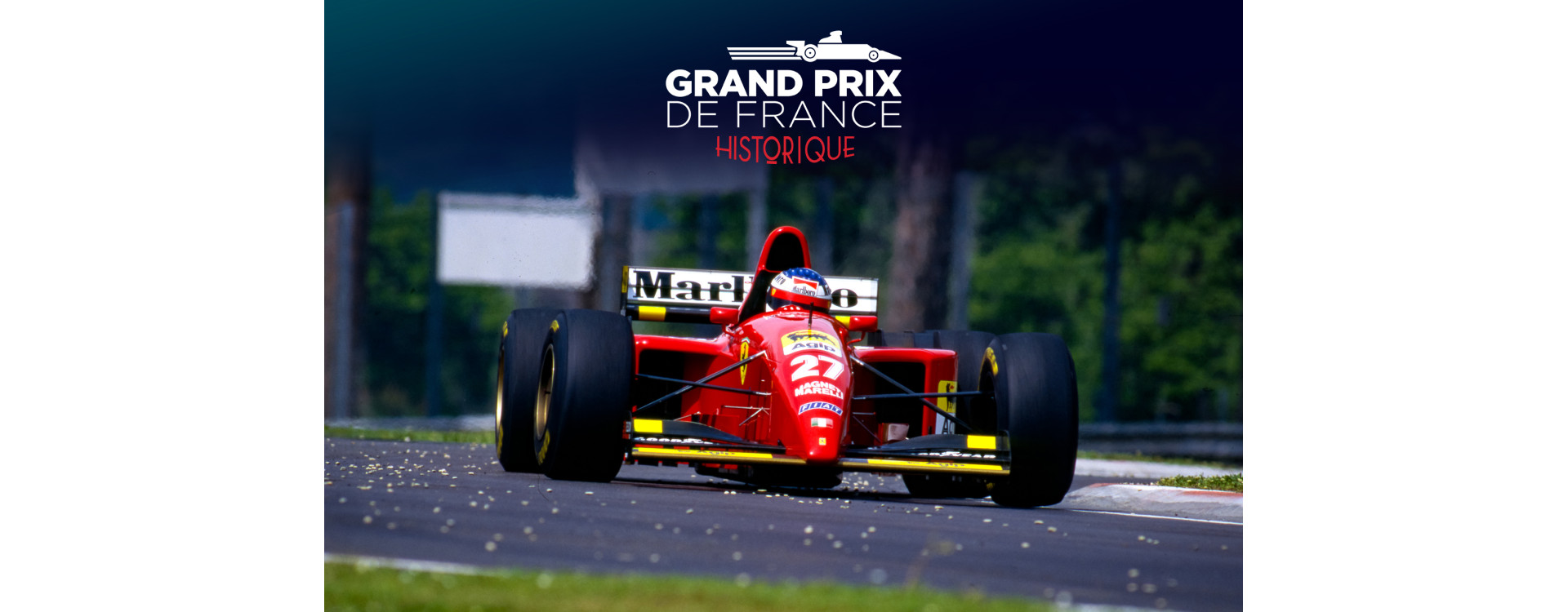
JEAN ALESI REUNITED WITH THE FERRARI OF HIS VICTORY AT THE 1995 CANADIAN F1 GRAND PRIX
Jean Alesi will drive the 1995 Ferrari 412 T2
The last Formula 1 car in history to win a race powered by a V12 engine
And one of the most beautiful single-seaters of its generation
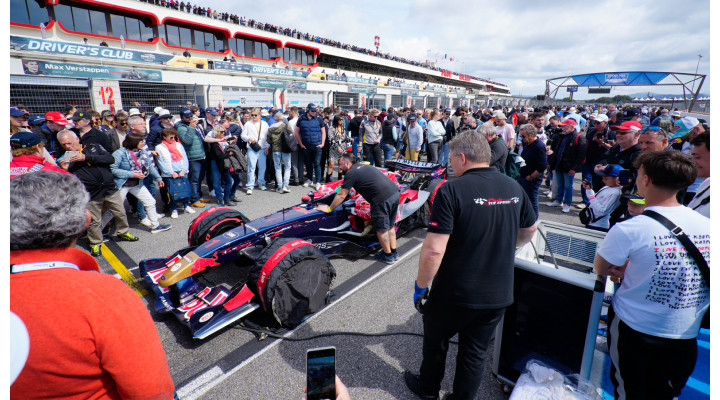
The KENNOL Grand Prix de France Historique made a huge impact last year, with a record attendance of 106,000 spectators and the presence of many major figures from the world of motorsport. The same will be true on May 8, 9 and 10, as several Formula 1 drivers – some still active – have already confirmed their attendance at Paul Ricard. The first to reveal his identity is none other than the circuit’s president: Jean Alesi… And the Avignon native won’t be coming empty-handed!
EMOTIONS AHEAD
While Jean Alesi’s presence at the KENNOL Grand Prix de France Historique comes as no surprise, seeing the President of Circuit Paul Ricard back behind the wheel of the Ferrari 412 T2 certainly does. This car is the most iconic of his career—the very one that allowed him to claim victory at the 1995 Canadian Grand Prix. That moment remains legendary in Formula 1 history, as it was Jean Alesi’s only win among 32 podiums and 201 starts.
The Ferrari 412 T2 is also regarded as one of the most beautiful single-seaters of its era, standing out from its contemporaries thanks to its plunging nose, far more elegant than the raised noses typical of the 1990s. Designed in England—heresy!—by John Barnard, it was innovative for featuring a clutch lever located behind the steering wheel, a system intended to give drivers more sensitivity at the start. Jean Alesi never used it in races! He always preferred the good old pedal, and his explosive launches proved him right.
Finally, the Ferrari 412 T2 went down in history as the very last Formula 1 car to win a race — across all manufacturers — to be powered by a V12 engine: the 3.0-liter Tipo 044. A true engineering gem, capable of producing 720 horsepower at 14,500 rpm. Enough to make the grandstands of the KENNOL Grand Prix de France Historique vibrate!
Jean Alesi, President of Circuit Paul Ricard:
“I can’t wait to drive the Ferrari 412 T2 again—the best F1 car I’ve ever had the chance to drive. It was fast and well-balanced, but unfortunately fragile. People remember my victory in Montreal in 1995, but they often forget that I was also in contention to win in Barcelona, Silverstone, Spa-Francorchamps, Monza and Suzuka. In fact, the 1995 Japanese Grand Prix was probably the finest race of my career. It started badly, though, as I was penalized with a stop-and-go for jumping the start due to the downhill straight. Furious about that unfair decision, I came back with a knife between my teeth and closed in on Michael Schumacher’s Benetton in just six laps—before the differential broke. This car holds a very special place in my tifosi heart.”
ESTEBAN OCON ATTENDING FOR THE FIRST TIME!
Esteban Ocon will take part in the KENNOL Grand Prix de France Historique for the first time. The French driver, set to race with the Haas F1 Team in 2026, will take to the track on Saturday as part of the “Fast & Famous” Formula 1 demonstration.
OVER 200 CARS RACING
Seven grids and 12 races over the weekend
Single-seaters, endurance and touring cars
Spectacle by day and by night
In addition to Formula 1 demonstrations by legendary drivers, the weekend will feature a continuous succession of races—something for everyone!
MASTERS RACING LEGENDS
F1 from 1966 to 1985 / Two 25-minute races
The grid brings together Formula 1 cars built during the most engineering-rich period in the sport’s history. From the “rolling cigars” of the mid-1960s to flat-bottom cars, via fearsome ground-effect machines, the appearance of these single-seaters never fails to amaze. New for the 2026 edition: turbocharged engines are now allowed.
F2 CLASSIC INTERSERIES
F2 from 1967 to 1978 / Two 11-lap races
In the 1960s and 1970s, Formula 2—the gateway to F1—was not a single-make series, but an open category where the best specialist constructors competed: Brabham, Chevron, Lola, March, Martini, and others. Powered first by 1.6-liter and later 2-liter engines, these 500-kg single-seaters featured future greats such as Jacky Ickx, Jean-Pierre Beltoise, Jean-Pierre Jabouille and René Arnoux.
F3 CLASSIC INTERSERIES
F3 from 1971 to 1984 / Two 10-lap races
In the 1970s and 1980s, every young driver in Formula 3 dreamed of winning at Monaco under the watchful eyes of Formula 1 team bosses. The unofficial rule was that the winner would move straight into F1 the following year, without passing through F2. The roll of honor includes Patrick Depailler, Jacques Laffite, Didier Pironi and Alain Prost. The cars—Martini, Chevron, March or Ralt—have been restored in their original liveries.
FORMULA RENAULT CLASSIC
Formula Renault from 1972 to 2009 / Two 10-lap races
After their karting years, many drivers—such as Felipe Massa, Kimi Räikkönen and Lewis Hamilton—made their single-seater debut via FR2.0 or F4. Built between 2000 and 2009 and powered by the 2-liter four-cylinder engine from the Clio II RS, the Tatuus FR2000 was the most widely produced single-seater in the world, with nearly 1,000 units competing across Europe, Asia and the Americas.
MASTERS ENDURANCE LEGENDS
Prototypes and GTs from 1995 to 2016 / One 100-minute race
This series features some of the most beloved cars among Millennials and Gen Z—unsurprisingly, as they’ve all driven them on simulators! Just like at Le Mans, racing takes place by day and night on Saturday evening. As at Le Mans, prototypes and GTs share the track. The fastest are the LMP1 cars (Lola, Peugeot, Pescarolo, Zytek), but seasoned fans always keep an eye on the GT battles (Aston Martin Vantage, Bentley Continental, Ferrari 458, BMW Z4).
MASTERS GROUP C
Prototypes from 1982 to 1993 / Two 30-minute races
Based on fuel-consumption limits, Group C regulations gave designers great freedom. Independent constructors such as Courage, Rondeau and Spice took advantage of this, though they couldn’t challenge Porsche’s dominance in the early 1980s. The response eventually came from other manufacturers: first Lancia, then Jaguar, Mercedes, Toyota, Nissan, Mazda and Peugeot in the early 1990s.
200 KM OF THE GPFH
Prototypes, pre-2001 GT and Touring Cars / One 90-minute race
In historic racing, a 90-minute race already counts as endurance. Here, as at the 24 Hours of Le Mans, up to three drivers can share a car—but the boldest (and fittest) can also race solo. As for eligible models, the lineup looks straight out of a video game: Chrysler Viper GTS-R, Ford GT40, Porsche 935 K3, Shelby Cobra…
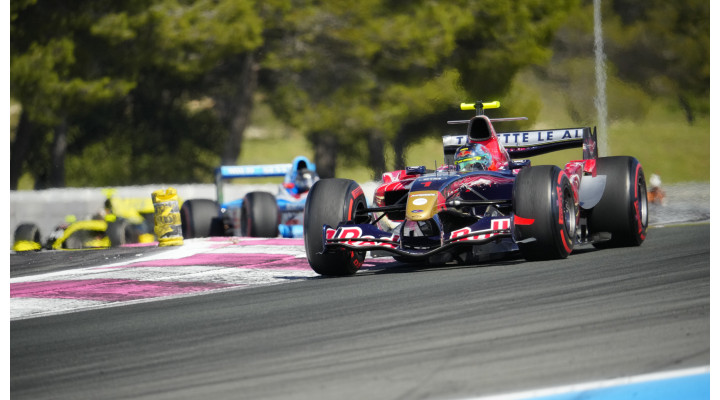
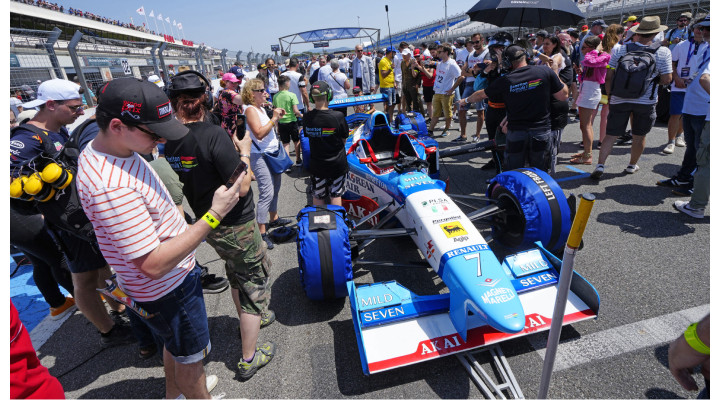
The KENNOL Grand Prix de France Historique is the only event in France to offer genuine Formula 1 races. Founded in 2017 by HVM Racing with the support of the French Motorsport Federation (FFSA), it has been co-organized with Circuit Paul Ricard since 2023. Each year, nearly 200 race cars—including more than 60 iconic Formula 1 cars from the 1970s to the 2010s—take part. The 2025 edition welcomed over 106,000 visitors from 21 different nationalities, confirming the event’s growing appeal and international reach.
More information at: www.grandprixdefrancehistorique.com
Related posts